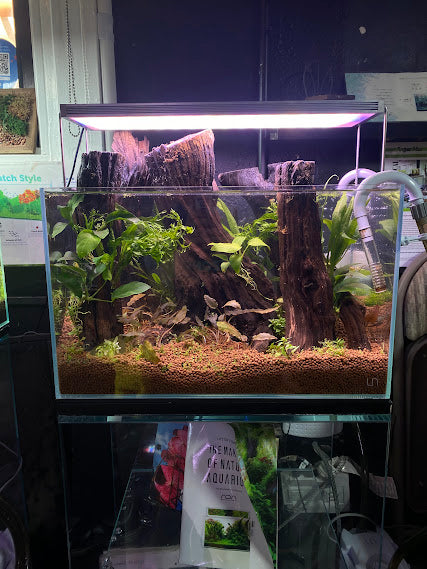
Most "I can't keep plants alive" stories trace back to one decision made at the store: buying whatever looked best in the display tank, not what matches the light and effort level of the tank waiting at home. A handful of aquarium plants are genuinely difficult to kill — they tolerate low light, skip CO2 injection entirely, and forgive inconsistent dosing while you find a routine. This guide compares 14 of them by placement, light, and CO2 need, then covers the handful of real traps: a moss ball that isn't a plant, floating plants that need more light than you'd expect, and one extremely "easy" plant you should probably still avoid. If you haven't settled on a tank setup yet, start with our first planted tank guide, which covers substrate and lighting basics this guide builds on.
What makes a plant "beginner-easy"
Three traits, and the best beginner plants share all three: they tolerate low light without stalling out, they don't require CO2 injection to survive, and they're forgiving of an inconsistent fertilizer routine while you're still learning your tank's rhythm. None of that means slow or boring — several plants below grow fast enough to be genuinely useful, soaking up the excess nutrients a new, still-cycling tank tends to have. It does mean none of them demand precision to stay alive, which is the entire point for a first tank.
14 beginner plants compared
Each of these has a full care guide with more detail; this table is for picking which ones fit your tank before you read further.
| Plant | Placement | Light | CO2 |
|---|---|---|---|
| Anubias | Attach to wood or rock | Low to moderate | Not required |
| Java fern | Attach to wood or rock | Low | Not required |
| Java moss | Attach to wood, rock, or mesh | Low to moderate | Not required |
| Christmas moss | Attach to wood or rock; carpet | Low to medium | Not needed |
| Amazon sword | Background, substrate-rooted | Moderate | Not required |
| Vallisneria | Background, substrate-rooted | Low to moderate | Not required |
| Cryptocoryne wendtii | Midground, substrate-rooted | Low to moderate | Not required |
| Dwarf sagittaria | Foreground to midground, carpet | Low to medium | Optional |
| Bacopa caroliniana | Background, stem plant | Medium | Optional |
| Anacharis (Egeria) | Background or floating | Moderate | Not required |
| Hornwort | Floating or anchored, stem | Low to medium | Optional |
| Amazon frogbit | Floating | Moderate to high | Not required |
| Duckweed | Floating | Low to high | Not needed |
| Marimo moss ball | Anywhere, loose | Low | Not needed |
Attached to hardscape: anubias, java fern, and moss
Anubias and java fern are epiphytes — their rhizome attaches to driftwood or rock rather than rooting in substrate, which is why they tolerate almost any substrate choice and most beginner neglect. The one rule that matters for both: never bury the rhizome, the thick horizontal stem the leaves grow from. Buried, it rots; left sitting on top of the hardscape and tied or glued in place, it's essentially bulletproof. Anubias grows slowly — roughly one new leaf every two to four weeks — and tolerates a wide range of conditions, though intense light with weak flow invites spot algae on its broad, slow-growing leaves. Java fern propagates two ways: splitting an established rhizome, or letting a leaf float until a plantlet forms at its tip and can be separated.
Java moss and Christmas moss attach the same way, to wood, rock, or mesh, and tolerate the same low-to-moderate light range without CO2. Both are slow growers that benefit from a grazing cleanup crew like amano shrimp to stay free of debris, and both make genuinely useful cover for shy fish, shrimp, and fry — java moss as a loose mat, Christmas moss trimmed closer for a carpet-like look on rock or driftwood.
A marimo moss ball isn't actually a moss, or even a true aquatic plant — it's a ball of cladophora algae that grows in a dense, round shape. That's why it tolerates low light and needs no fertilizer or CO2 at all: gently roll it during water changes so it stays round and lit evenly on all sides, the same way you'd rotate it in the wild current it evolved in.
Rooted in substrate: sword, val, crypt, and dwarf sagittaria
Amazon sword is a background root-feeder that depends far more on root tabs than on lighting or substrate choice — feed it well and it rewards you with large leaves and, eventually, baby plantlets on runners. New leaves coming in yellow is usually a sign it needs more root tabs, not more light. Vallisneria ("val") is similar in undemanding light and nutrient needs, sending up tall, grass-like leaves and spreading on its own via runners — it can outgrow a small tank quickly and benefits from occasional thinning, and fish that dig or graze on plants can disturb it before it's established.
Cryptocoryne wendtii ("crypts") tolerates almost any light level and is one of the most forgiving midground root-feeders available, needing root tabs roughly every three months in inert substrate. It's also notorious for "crypt melt" — leaves dissolving within days of being moved to a new tank or replanted — which is transplant shock, not disease, in the large majority of cases; healthy roots regrow new leaves from the base within a few weeks. Dwarf sagittaria is the one true carpeting plant on this list: under high light it stays short and spreads into a dense foreground mat, while under low light the same plant grows taller instead, so match your expectations to your fixture before counting on a carpet.
Fast stem plants: good for a new tank's nitrates, not just decoration
Anacharis (Egeria densa) and hornwort are the two fastest growers here, and that speed is genuinely useful rather than just a maintenance chore: both pull nitrate and ammonia out of the water quickly, which makes them a smart addition to a newly cycling tank. Neither needs CO2 injection, and neither needs to be rooted — both grow fine anchored lightly in substrate or simply left loose and floating, with cuttings rooting easily if you want to replant a trimmed top. Hornwort sheds its needle-like leaves if handled roughly or moved between tanks, which looks alarming but isn't a sign of a dying plant. Bacopa caroliniana is a slower, more structured stem plant for the background — it tolerates low light but develops a coppery-red tint at its tips under stronger light and iron dosing, and its lower stems bare out over time, so trim the tops and replant them to keep a full-looking stand.
Floating plants, and the light trap most beginners miss
Floating plants seem like the obvious "easy" category — no substrate, no root tabs, nothing to plant — but they expose a light-level trap worth understanding before you buy one. A floating leaf sits right at the surface, directly under the fixture, while a rooted plant's leaves sit lower in the water column where the light has already lost intensity on the way down. That's why a tank can be "low light" for what's planted in the substrate while still being plenty bright for something floating on top, and why amazon frogbit actually wants moderate to high light rather than the dim conditions you might assume a "floating" plant tolerates. Red root floater takes this further still — it needs strong light to hold its color and isn't a true beginner plant despite how often it's marketed as one; skip it until you've got a stronger fixture and some experience reading how your other plants respond to it.
Duckweed sits at the opposite extreme: it tolerates almost any light level, low to high, and multiplies fast enough to cover a tank's surface within weeks, shading out everything growing below it. It's a legitimately useful nutrient sponge in a quarantine or grow-out tank where appearance doesn't matter, but it's nearly impossible to fully remove once it's established in a display tank — most keepers who add it on purpose end up regretting it later.
Common beginner plant-buying mistakes
- Buying for the display tank's lighting, not your own — a plant thriving under a store's high-output fixture can stall or die under a dimmer home setup, and vice versa for shade-tolerant plants under strong light.
- Burying an anubias or java fern rhizome because it looks more "planted" that way — it rots. Tie or glue it to hardscape instead.
- Pulling a "dying" crypt or sword within days of replanting, when melting leaves are transplant shock, not a terminal problem, as long as roots stay intact.
- Adding duckweed or red root floater without knowing what they actually need — one takes over, the other needs more light than most beginner tanks have.
- Assuming root tabs help everything — epiphytes like anubias, java fern, and moss get essentially no benefit from fertilizer buried in the substrate; they need liquid dosing instead. Our plant fertilizer guide covers the full dosing routine once you've picked your plants.
What's the single easiest aquarium plant for an absolute beginner?
Anubias and java fern, in a tie. Both attach to driftwood or rock instead of rooting in substrate, tolerate low light, don't need CO2 injection or fertilizer dosing to survive, and grow slowly enough that neglect barely shows. You can keep either in plain gravel with zero root tabs and nothing will go wrong.
Do any of these plants need CO2 injection?
No. Every plant in this guide grows without injected CO2. A few — bacopa caroliniana, dwarf sagittaria, and hornwort — grow faster and more compact with it, but none require it, and adding CO2 to chase faster growth on a beginner tank usually just adds a new way for things to go wrong.
Is duckweed a good beginner plant?
It's easy to grow, which is exactly the problem. Duckweed tolerates almost any light and water condition and multiplies fast enough to blanket a tank's surface within weeks, blocking light to everything below it. It's genuinely useful for soaking up excess nitrate in a quarantine or grow-out tank, but it's nearly impossible to fully remove once established in a display tank — most keepers who add it on purpose regret it.
Why do floating plants sometimes need more light than rooted ones, even in a "low light" tank?
A floating plant's leaves sit at the water's surface, right under the fixture, while a rooted plant's leaves are lower in the tank where the light has already lost intensity passing through the water. That's why amazon frogbit wants moderate to high light and red root floater wants strong light specifically, even though both are "floating plants" in a tank that might otherwise be considered low-light for whatever's rooted in the substrate below.
Can I grow these plants without buying a nutrient-rich substrate?
Yes, for most of them. Anubias, java fern, java moss, and Christmas moss attach to hardscape and get essentially nothing from the substrate either way. Root-feeders like amazon sword, vallisneria, cryptocoryne, and dwarf sagittaria will grow in plain gravel or sand too — they just need root tabs pushed in near their roots every one to three months, since inert substrate supplies no nutrients on its own.
Why did my new plant's leaves turn brown or mushy right after I planted it?
That's usually transplant shock, not disease — cryptocoryne is especially known for "melting" within days of being moved or replanted. As long as the roots and rhizome stayed intact, new growth typically regrows from the base within a few weeks. Pulling a melting plant out as a loss before giving it that time is the most common overreaction beginners make.