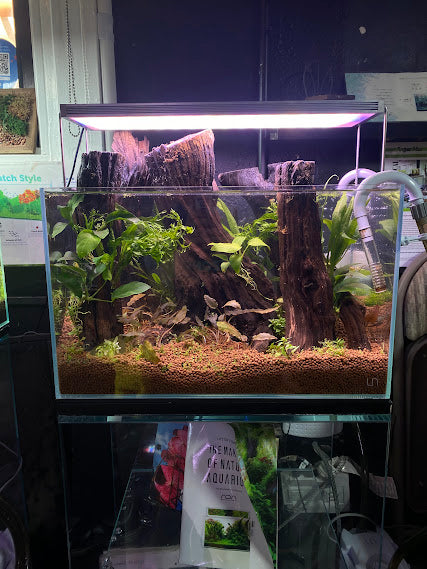
A biotope aquarium isn't just a tank that looks natural — it's one where the fish, plants, hardscape, and water chemistry all trace back to one real place: a specific river, lake, or stream system, not just "South America" or "Africa" in general. That distinction matters more than it sounds: a Malawi rift-lake cichlid and a Congo River tetra are both African, but one needs hard, alkaline water over bare rock and the other needs softer, nearly neutral water with driftwood, so they'd never actually share a stretch of wild water despite sharing a continent.
Done right, a biotope also solves a problem every mixed community tank fights: parameter overlap. When every resident evolved in the same water, there's no compromise between a fish that wants it soft and acidic and one that wants it hard and alkaline — the chemistry is simply correct for everything in the tank at once. This guide covers four of the most-kept biotope types, their real water parameters and hardscape, and how to stock one without quietly drifting back into a generic "natural-looking" tank.
Four biotope types at a glance
| Biotope | Example region | pH | GH | Temperature | Hardscape | Example stock |
|---|---|---|---|---|---|---|
| South American blackwater | Amazon / Rio Negro basin | 4.5–6.5 | 1–4 dGH | 76–82°F | Driftwood, leaf litter, botanicals | Cardinal/rummy-nose tetra, apistogramma, corydoras |
| Southeast Asian peat swamp | Borneo / Sumatra blackwater | 3.5–6.0 | 0–3 dGH | 76–82°F | Driftwood, dense leaf litter, botanicals | Wild betta species, Boraras, licorice gourami |
| Central/West African river | Congo River | 7.0–7.8 | 6–12 dGH | 76–80°F | Rock, driftwood, moderate current | Congo tetra, African butterfly fish, upside-down catfish |
| African Rift Lake | Lake Malawi / Lake Tanganyika | 7.8–9.0 | 10–20 dGH | 75–82°F | Rock piles or sand only — no driftwood | Mbuna cichlids, peacock cichlids, shell-dwellers |
These four aren't the only biotopes aquarists keep — hillstream/rheophilic setups (fast, cool, oxygen-rich water for loaches and hillstream loaches) and brackish mangrove biotopes are both real categories too — but they're the four with the most established keeping history and the widest fish and hardscape availability, which makes them the most practical starting points.
South American blackwater: the Amazon look, with real chemistry behind it
Blackwater rivers like the Rio Negro get their tea-dark color from dissolved tannins leaching out of fallen leaves and wood, not from poor water quality — this is some of the softest, most acidic water any aquarium fish naturally lives in. Hardscape leans on driftwood, dried leaf litter (catappa or oak leaves are the usual aquarium substitutes), and botanicals like seed pods, all left to tint the water rather than treated as decor to be rinsed clean. True wild Amazon tributaries run warmer than most people expect for a "cold tannin stream" — mid-to-upper 70s to low 80s°F is typical, not the 68–72°F range some keepers assume from the murky look.
Most tap water needs cutting with RO/DI water to reach the GH this biotope calls for, since municipal supplies are rarely anywhere near 1–4 dGH on their own. Plant life in the wild is sparse under the tannin-stained, light-blocked water, so a faithful build leans on driftwood structure and leaf litter rather than a dense plant carpet — floating plants like Amazon frogbit are a more accurate choice than rooted stem plants.
Southeast Asian peat swamp: even softer, even darker
Peat swamp forests across Borneo and Sumatra produce some of the most extreme water chemistry any aquarium fish tolerates — pH can run below 4 in the wild, with GH close to zero. This is the native water for several wild betta species, Boraras (the "mini rasbora" group), and licorice gouramis, all adapted to water most other freshwater fish couldn't survive in. The hardscape mirrors South American blackwater closely — driftwood and heavy leaf litter — which is part of why the two biotopes get confused for each other, but the fish lists don't overlap, and this biotope's pH floor runs noticeably lower.
Because the chemistry is so extreme, this is one of the least forgiving biotopes for a first attempt — RO/DI water is close to mandatory, and even then, dialing pH down into the 4s safely (without crashing it) takes more patience than most of the other three types on this list.
Central/West African river: moderate water, moving current
The Congo River system sits in the middle of the hardness spectrum — soft to moderately hard, neutral to slightly alkaline, a real contrast to both the acidic blackwater biotopes above and the hard, alkaline rift lakes below. Congo tetras, African butterfly fish, and upside-down catfish all come from here, and the current in much of this system runs stronger than a typical community tank, so a biotope build usually runs extra flow rather than the gentle circulation suited to blackwater setups. Hardscape mixes rock and driftwood, sometimes including large flat stones angled to suggest the rapids and waterfalls found through parts of the basin.
African Rift Lake: hard, alkaline, and almost entirely rock
Lakes Malawi and Tanganyika are the opposite end of the water-chemistry spectrum from every biotope above — hard, strongly alkaline water, with dissolved minerals from the surrounding rock pushing pH as high as 9 in parts of Tanganyika. There's no driftwood and no tannins in either lake, and almost no live plants survive the combination of herbivorous cichlids and mineral-heavy water, so a faithful build is essentially rockwork: piled boulders for Malawi's mbuna, or a mix of large rocks and empty shells for Tanganyika's shell-dwelling species. This is also the biotope most beginners can attempt with the least water-chemistry adjustment, since many municipal water supplies already sit closer to this range than to any of the soft-water biotopes above.
Don't treat "African" as one biotope. A Malawi mbuna and a Congo River tetra are both African fish, but their wild water couldn't be more different — hard and alkaline versus soft and neutral. Match the specific lake or river system, not the continent.
Stocking a biotope honestly
The discipline that separates a real biotope from a "natural-looking" tank is in the stock list, not the decor. Before adding a fish, check that it actually comes from the water system the tank is built around — not just the same country or continent. A few guardrails that keep a biotope honest:
- Match the river system, not the hemisphere. "South American" covers both soft blackwater tributaries and much harder whitewater rivers — a fish from one doesn't belong in a biotope built for the other.
- Check for range overlap, not just habitat type. Two species can both be blackwater fish and still never meet in the wild if their ranges are thousands of miles apart on different rivers.
- Resist "just one" exceptions. A single out-of-range fish, however well it would tolerate the water, breaks the premise the same way one wrong ingredient breaks a recipe — it's no longer that place.
- Let scarcity guide stocking, not just color or pattern. Some well-matched biotope fish are plainer than a generic community-tank favorite; the payoff is scientific accuracy, not maximum color.
For the water-chemistry side of all four biotopes above, our water parameters guide covers what GH, KH, and pH actually measure and how to test and adjust them; fish compatibility covers temperament and tankmate fit once the chemistry side is settled.
Common biotope mistakes
- Decorating by continent instead of by water system. The single most common shortcut — and the one that turns a biotope back into a generic "natural" tank.
- Skipping RO/DI water for a soft-water biotope. Most tap water is nowhere near soft or acidic enough for Amazon or Southeast Asian blackwater fish without real adjustment.
- Adding live plants to a rift lake build. Most African cichlids eat or uproot anything soft; a few tough, rhizome-based plants like Anubias wedged into rock crevices are about the realistic ceiling.
- Cleaning out all the tannins. Running carbon or frequent water changes to keep blackwater tanks "clear" fights the exact water chemistry the biotope depends on.
- Treating current as optional. A Congo River build with still water misses a defining feature of that system as much as the wrong hardscape would.
What actually makes a tank a "biotope" instead of just natural-looking?
A biotope matches fish, plants, water chemistry and hardscape to one real place — a specific river, lake or stream system — rather than combining whatever looks good together. A heavily planted Amazon-themed tank stocked with African cichlids and driftwood isn't a biotope, even if it looks lush and "natural," because none of those elements share a real wild water source. The test isn't how natural a tank looks; it's whether everything in it could plausibly be scooped from the same stretch of water.
Do I need wild-caught fish for a real biotope?
No. Nearly every fish sold for biotope aquariums is captive-bred, and that's preferable — it avoids pressuring wild populations and adjusts more easily to tank water than a wild-caught import. What matters is the species' natural range and water chemistry, not whether an individual fish was born in that river.
Can I mix fish from the same continent but different water systems?
Not in a strict biotope. A Rio Negro blackwater tetra and a Lake Malawi rift cichlid are both technically "South American" versus "African," but within Africa alone, a Malawi cichlid (hard, alkaline water) and a Congo River tetra (soft, neutral water) come from chemically incompatible systems despite sharing a continent. A true biotope matches the specific river, lake or stream system, not just the hemisphere.
Is a biotope aquarium harder to maintain than a mixed community tank?
Not necessarily — often the opposite, once it's set up correctly. Because every resident shares the same wild water chemistry, there's no parameter compromise to manage between species with conflicting needs. The harder part is almost always research and initial setup (sourcing the right hardscape, dialing in soft or hard water correctly) rather than ongoing upkeep.
Which biotope is easiest for a beginner to start with?
An African Rift Lake setup (Malawi or Tanganyika) is usually the most forgiving, because most tap water is already moderately hard and alkaline, so little adjustment is needed — just rock, sand, and patience with cichlid aggression. A soft, acidic blackwater biotope (Amazon or Southeast Asian peat swamp) is harder for a beginner specifically because most tap water needs softening with RO/DI water before it's in range.
Can a biotope aquarium still be heavily planted?
It depends which biotope. Blackwater Amazon and Southeast Asian peat-swamp tanks are naturally plant-sparse in the wild — tannin-stained water blocks light, so most "planting" is really floating plants, root tangles and leaf litter rather than a lush carpet. Rift lake biotopes are plant-sparse for a different reason: most African cichlids eat or uproot soft vegetation, so algae and a handful of tough plants like Anubias or Vallisneria wedged between rocks are the realistic ceiling.