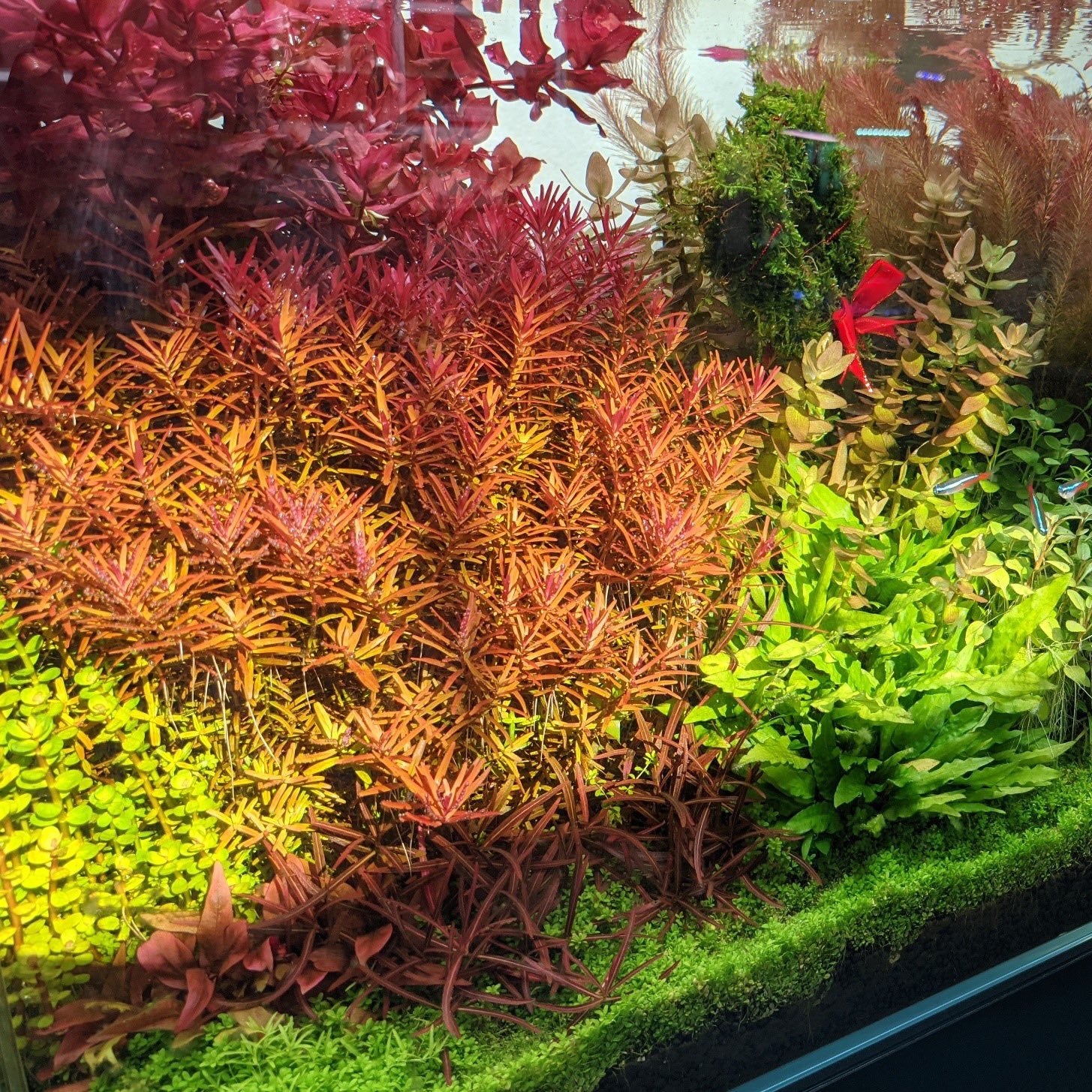
Most "my plants won't grow" problems aren't a lighting or CO2 problem at all — they're a fertilizer problem, and usually a specific, identifiable one. Aquarium plants need the same macronutrients (nitrogen, phosphorus, potassium) and micronutrients (iron, magnesium, calcium, and other trace elements) as any plant, and a deficiency in any one of them shows up as a fairly predictable leaf symptom: yellowing in a specific pattern, pinholes, stunted new growth, or leaves that come in small and pale. This guide covers how to read those symptoms, the difference between liquid fertilizer and root tabs, and how to build a dosing routine that actually matches your tank instead of guessing. If you haven't set up a planted tank yet, start with our first planted tank guide, which covers substrate, lighting, and the fertilizing basics this guide builds on.
Macronutrients vs. micronutrients, in plain terms
Macronutrients are what plants need in relatively large amounts: nitrogen (N), phosphorus (P), and potassium (K) — the "NPK" on any fertilizer label. Micronutrients, sometimes called trace elements, are needed in much smaller amounts but are just as essential: iron is the big one for visible health, alongside manganese, magnesium, calcium, and a handful of others. A tank with fish already supplies some nitrogen and phosphorus through waste and the nitrogen cycle (see our cycling guide), but rarely enough for a heavily planted tank, and almost never enough micronutrients. That gap is what fertilizer dosing fills.
One pattern worth knowing before the symptom table below: some nutrients are "mobile" inside the plant and some aren't. Nitrogen is mobile — when it's short, the plant pulls it out of older leaves to feed new growth, so nitrogen deficiency shows up on old leaves first. Iron and most micronutrients aren't mobile, so a shortage shows up on new growth instead while older leaves stay green. That's the fastest way to narrow down what's actually wrong before you reach for a bottle.
Diagnosing deficiencies by leaf symptom
Match what you're seeing to the row below, then check which growth is affected — older leaves or newer leaves — since that's the detail that separates look-alike deficiencies.
| Nutrient | Symptom | Affected growth | Fix |
|---|---|---|---|
| Nitrogen | Yellowing, translucent leaves, often starting at the tips | Older leaves | Increase all-in-one fertilizer dose; match it to plant mass as the tank fills in |
| Iron | Yellowing or paleness with veins that stay darker green | New growth | Add an iron-specific supplement — general fertilizer rarely carries enough iron alone |
| Potassium | Small pinholes, sometimes rimmed brown or yellow | Older leaves | Increase all-in-one dose first; add a potassium supplement if it persists |
| Phosphate | Yellowing with soggy brown patches | Older leaves | Remove phosphate-absorbing filter media if present; otherwise dose fertilizer normally |
| Magnesium | Pale leaves with dark veins, sometimes drooping edges | Older leaves | Dose more all-in-one fertilizer, or a magnesium-specific supplement |
| Calcium | New leaves grow twisted or gnarled | New growth | Raise GH with a mineral or hardness-boosting supplement — usually a low-GH water issue |
This table reflects the leaf-symptom patterns documented by Aquarium Co-Op's plant nutrient deficiency guide. One caution worth repeating: more than one deficiency can overlap, and a tank running low on everything (an under-dosed tank) can show a blurrier mix of symptoms than a tank missing just one nutrient. When in doubt, start by correcting the dosing routine as a whole before chasing a single trace element.
Rule out the obvious non-fertilizer causes first: transplant shock (new crypts and stems commonly melt or drop a few leaves in their first week or two, which isn't a deficiency), and low light or unstable CO2, which can produce pale or stunted growth that looks similar to a nutrient problem but won't improve no matter how much you dose.
Liquid fertilizer, root tabs, or both?
Which delivery method a plant benefits from depends on how it feeds — through its leaves, through its roots, or both.
| Method | Feeds | Best for | Frequency |
|---|---|---|---|
| Liquid (all-in-one) fertilizer | Leaves, via the water column | Anubias, java fern, mosses, floating plants, stem plants | Weekly for low-tech; 2-3x/week for high-light or high-tech tanks |
| Root tabs | Roots, directly in the substrate | Cryptocoryne, vallisneria, swords, other rooted plants | Every 1-3 months, per label (push in near, not under, the root mass) |
| Dry/bulk ferts (EI-style) | Leaves, via the water column | High-tech, high-light, CO2-injected tanks with fast growth | 3x/week macros, alternating 3x/week micros, with a large weekly water change |
Epiphytes like anubias and java fern, which attach to hardscape instead of rooting in substrate, get essentially no benefit from root tabs since their roots aren't buried — don't skip their liquid dose assuming root tabs have it covered. Most mixed community planted tanks end up using liquid fertilizer as the baseline and root tabs as a supplement under anything rooted, which matches the routine in our first planted tank guide.
EI dosing, for tanks that have outgrown "weekly and done"
Estimative Index (EI) dosing is the standard method once a tank moves past low-tech: instead of testing water to hit an exact nutrient target, you deliberately dose a slight excess of nutrients several times a week, then perform a large water change — typically 50% — on a fixed day to reset everything before anything builds up to a harmful level. A commonly used schedule doses macronutrients (potassium nitrate, potassium phosphate, potassium sulfate) three times a week, alternates trace elements on the days in between, and resets with the weekly water change, with dose volume scaled to tank size (UKAPS forum, Estimative Index dosing for beginners). The logic is simple: because you know exactly what went in and a known fraction comes back out each week, you can estimate concentrations without a single test kit reading.
EI assumes stable, adequate CO2 and strong light driving fast growth — it's built for high-tech tanks, not a beginner's first low-tech setup. If your tank is low-light with no CO2 injection, EI-level dosing is more nutrient than your plants can use, and the excess just becomes algae fuel. Save it for a tank that's already outgrowing a simple weekly dose.
A simple routine for most tanks
For a low-tech or beginner planted tank, this covers the large majority of cases without any test-kit math:
- Liquid all-in-one fertilizer: once a week, at the label's low-tech dose, timed with your water change.
- Root tabs: under cryptocoryne, vallisneria, swords, and other rooted plants, every 1-3 months per the product label.
- Adjust up, not down, as the tank fills in: a newly planted tank needs less than the same tank six months later with twice the plant mass — increase the dose gradually as growth increases, rather than starting at a high-tech rate from day one.
Move to a more structured routine like EI only once you've added CO2 injection or stronger lighting and a weekly dose is visibly not keeping up — new leaves coming in smaller, slower growth than before, or the deficiency symptoms above showing up despite dosing. See our aquarium maintenance schedule for how fertilizer dosing fits into the rest of a weekly routine.
Common fertilizing mistakes
- Dosing a high-tech schedule on a low-light tank — the excess nutrients don't get used, they feed algae instead.
- Assuming root tabs cover everything — epiphytes like anubias and java fern need liquid dosing regardless of how many root tabs are in the substrate.
- Chasing one symptom with one supplement before checking whether the whole tank is simply under-dosed.
- Mistaking transplant shock for deficiency and increasing fertilizer right after planting, when the real fix is patience.
- Changing fertilizer, light, and CO2 all at once when troubleshooting — change one variable, wait two weeks, and see what actually shifted.
How do I know if my plants are deficient versus just adjusting to a new tank?
Minor melting or a few lost leaves in the first week or two after planting is normal transplant shock, especially with crypts. A true deficiency shows a consistent pattern across multiple leaves or plants — yellowing that starts in the same spot every time, pinholes that keep appearing, or new growth that comes in smaller and paler than the leaves before it — and it gets worse over weeks rather than settling down.
What's the difference between liquid fertilizer and root tabs?
Liquid fertilizer dissolves into the water column and feeds plants that absorb nutrients through their leaves, including anubias, java fern, mosses, and stem plants. Root tabs are solid capsules pushed into the substrate that feed root-feeders like cryptocoryne, vallisneria, and swords directly at the root zone. Most planted tanks with a mix of plant types need both.
What is EI (Estimative Index) dosing and do I need it?
EI is a test-kit-free method that doses a slight nutrient excess several times a week, then resets everything with a large weekly water change so nothing can build up to harmful levels. It's built for high-light, high-tech tanks pushing fast growth. A low-tech beginner tank doesn't need it — a simple weekly all-in-one liquid dose is enough.
Can you over-fertilize a planted tank?
Yes, though plants tolerate a wider margin than most beginners assume. The real risk isn't toxicity to the plants themselves — it's feeding an imbalance that algae exploits, especially excess phosphate or nitrate relative to light and CO2. Dose at the label rate for your tank size and adjust gradually, not in big jumps.
Why do my new leaves yellow but old leaves stay green?
That pattern points to iron or another micronutrient deficiency. Mobile nutrients like nitrogen get pulled from old leaves to feed new growth when they're short, so nitrogen deficiency shows up on old leaves first. Iron and most micronutrients aren't mobile within the plant, so a shortage shows up on new growth instead while older leaves stay normal.
Do I need CO2 injection for fertilizer to work?
No. Fertilizer feeds plants in any tank, but how much they can use depends on light and CO2 together. A low-tech, low-light tank uses nutrients more slowly and needs a lighter, simpler dosing routine; a high-light or CO2-injected tank burns through nutrients faster and benefits from a more aggressive routine like EI. Match the dosing to the tank, not the other way around.