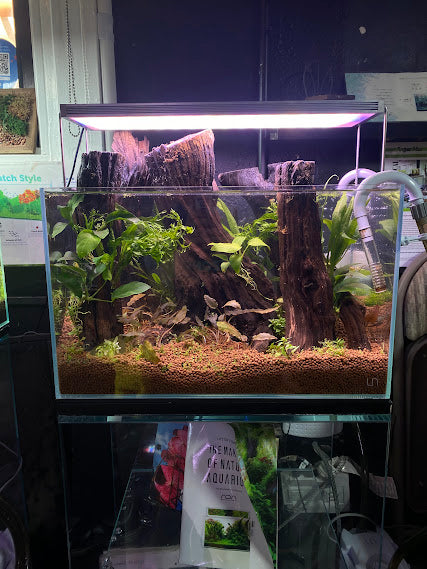
Aquarium lighting gets bought backwards more often than any other piece of equipment: by looks, by price, or by whichever fixture the tank's size recommends on the box. For a fish-only tank, that mostly works. The moment live plants are involved, three separate things start to matter — the type of light, its color temperature (Kelvin), and how intense it is (PAR) — plus how many hours a day it runs. Get the combination wrong and the most common result isn't dead plants, it's algae, because light that outpaces what your plants and CO2 can use just feeds whatever grows fastest without it. This guide covers all four pieces in plain terms. If you haven't set up a tank yet, start with our equipment guide for the basics on sizing a fixture to your tank; if algae is already the problem, our algae guide walks through diagnosing it directly.
LED vs. fluorescent: what actually differs
Almost every aquarium light sold today is LED, and for good reason — but older tanks and some budget fixtures still run T5 or T8 fluorescent tubes, and the differences are worth knowing if you're choosing between them or inherited a tank with one already installed.
| Type | Heat output | Typical bulb life | Notes |
|---|---|---|---|
| LED | Low — rarely needs a chiller | Years; commonly rated up to a decade of use | Spectrum stays consistent as it ages; higher upfront cost, lowest running cost |
| T5 fluorescent (incl. High Output) | Low to moderate | 12-18 months for usable output | Narrower tube than T8; HO versions run brighter and warmer |
| T8 fluorescent | Low — described as "cool operating" | 12-18 months for usable output | Older, wider standard; T5 and T8 tubes aren't interchangeable (different pin spacing) |
The bulb-life figures are the part most people miss: a fluorescent tube that still lights up after 18 months isn't necessarily still useful to your plants. Output and spectrum both fade well before the tube visibly dims or stops working (That Fish Place, Fluorescent Aquarium Lighting Basics). LEDs hold their spectrum far longer, which is the main reason they've become the default even outside of running cost (All Pond Solutions, Guide to Aquarium Lighting).
Color temperature (Kelvin): matching light to the look you want
Kelvin describes where a light sits on the warm-to-cool color scale, and for freshwater tanks it's mostly an aesthetic choice rather than a plant-health one — within reason, plants grow under any of the ranges below.
| Kelvin range | Look | Best for |
|---|---|---|
| Under ~4,000K | Warm, amber, sunset-toned | Amazon blackwater or driftwood-heavy biotope aesthetics; enhances reds in fish and wood tones |
| 5,000-6,700K | Neutral "daylight" | The standard default for freshwater planted tanks — matches natural midday sunlight |
| 8,000K and up | Crisp, bright white | Minimalist Iwagumi layouts and other high-contrast aquascaping looks |
| 10,000-20,000K | Blue-white to deep blue | African Rift Lake setups wanting a blue cast, and saltwater/reef tanks |
5,000-6,700K daylight-spectrum lighting is the figure most commonly cited as ideal for freshwater planted tanks (That Fish Place, Aquarium Lighting Guide), while warmer sub-4,000K light is favored specifically for the sunnier, reddish cast it gives Amazon-style biotopes, and 8,000K+ cooler light suits minimalist or African-cichlid-style layouts (Aquasabi, Light Temperature as a Design Element). If you're building toward a specific regional look, our biotope aquarium guide covers which Kelvin and hardscape pairing fits each real-world habitat.
PAR and light intensity: how much is "enough"
PAR (Photosynthetically Active Radiation) measures the light plants can actually use, and it's a far better guide than wattage or lumens, which only describe electrical draw or how bright a light looks to your eye rather than what reaches a plant's leaves.
| Light level | PAR (μmol/m²/s) | CO2 injection | Algae risk if nutrients lag |
|---|---|---|---|
| Low | 10-20 | Not needed | Low — both plants and algae grow slowly |
| Medium | 20-35 | Optional, but recommended | Moderate — faster growth needs more consistent maintenance |
| High | 40-50+ | Generally required | High without CO2 and a strict fertilizing schedule |
These ranges follow Aquarium Co-Op's commonly cited PAR benchmarks for planted tanks (Aquarium Co-Op, PAR for Planted Tanks); other sources define "low," "medium," and "high" light somewhat more broadly, so treat the exact numbers as a starting benchmark rather than a hard line. The practical takeaway matters more than the exact figure: light, CO2, and fertilizer all have to scale up together, covered in more depth in our plant fertilizer guide. Raising light alone, without adding the CO2 and nutrients to match, is one of the most common routes into an algae problem — see our algae guide for how that plays out by algae type.
Photoperiod: how many hours should the light be on
There's a real split in hobbyist advice here, worth stating plainly instead of picking a side. One school of thought argues for matching the roughly 12-13 hour day length most aquarium fish and plants evolved under in the wild, sometimes with a midday "lighting lunch break" built in to help control algae (Sera, Lighting Time in an Aquarium). In practice, most planted-tank keepers run noticeably shorter photoperiods than that, because every extra lit hour is also an extra hour feeding algae if nutrients or CO2 aren't perfectly dialed in:
- High-light or CO2-injected planted tanks: 6-8 hours, kept consistent day to day
- Low-tech planted or mixed community tanks: 8-10 hours
- Fish-only tanks with no live plants: 8-12 hours is mostly a viewing preference, not a biological requirement
If algae is already a recurring problem, shortening the photoperiod by an hour or two is one of the fastest, lowest-cost changes to make before buying a product to treat it — see our algae guide for the rest of the troubleshooting order.
Many modern LED fixtures also offer ramp-up and ramp-down dimming, easing fish from dark to full brightness over 15-30 minutes rather than snapping on instantly. It's not essential, but it's a low-effort way to reduce startle stress, especially for shy or nocturnal species.
Matching light to your tank
- Fish-only community tank: any daylight-spectrum LED sized to the tank; Kelvin and PAR aren't critical since there's nothing photosynthesizing to support.
- Low-tech planted tank: 5,000-6,700K, low-to-medium PAR (10-35), no CO2 required — see our first planted tank guide for a full low-tech setup plan.
- High-tech, CO2-injected planted tank: higher PAR (40+), paired with consistent CO2 and a full fertilizing routine, run on a shorter 6-8 hour photoperiod.
- Biotope or aesthetic-driven builds: Kelvin chosen for the look (warm for Amazon/blackwater, cool for Iwagumi or African Rift Lake) — see our biotope guide for pairing light with the right hardscape and parameters.
- Tanks with shade-seeking or nocturnal fish (many catfish, loaches, and wild bettas): floating plants or dense surface planting to break up direct light, and a photoperiod on the shorter end.
Common lighting mistakes
- Buying by wattage or lumens instead of PAR for a planted tank — neither number tells you what a plant can actually use.
- Running the light longer "to see the tank more" — every added hour is an added hour of algae-feeding light if CO2 and nutrients haven't also gone up.
- Keeping an old fluorescent tube because it still turns on — usable output and spectrum fade well before the tube visibly dims.
- Raising light intensity to fix slow plant growth without also checking CO2 and fertilizer, which usually just trades slow growth for an algae outbreak.
- No shaded area in the tank for shade-seeking or nocturnal fish under an otherwise appropriate planted-tank light.
Do I need an expensive full-spectrum LED, or will any light work?
For a fish-only tank with no live plants, almost any light that lets you see the fish is fine, including a basic LED strip. The moment you add live plants, spectrum and intensity start to matter, because plants need usable light (measured as PAR) across red and blue wavelengths to photosynthesize, not just enough lumens to look bright to your eye.
What Kelvin should I use for a planted tank?
5000K to 6700K, often labeled "daylight," is the standard default for a freshwater planted tank and works for nearly any community setup. Go warmer, under about 4000K, for an amber blackwater or Amazon biotope look, or cooler, 8000K and up, for a bright white Iwagumi or African Rift Lake aesthetic. All three support plant growth; the difference is mostly how the tank looks to you, not how well plants grow.
How many hours a day should my aquarium light be on?
Most high-light or CO2-injected planted tanks run 6 to 8 hours to keep algae in check, while low-tech planted and fish-only community tanks can usually run 8 to 10 hours without issue. A natural-day-length approach of 12 to 13 hours exists and can work in a well-balanced tank, but it leaves much less margin for error if nutrients or CO2 drift out of balance, so most hobbyists keeping an eye on algae land shorter.
Will more light make my plants grow faster?
Only up to a point, and only if CO2 and fertilizer keep pace. Light, CO2, and nutrients have to scale together; pushing one of the three up alone, usually light, is the single most common cause of algae outbreaks in planted tanks. If you're not ready to add CO2 injection and a full fertilizing routine, a lower-light setup is easier to keep balanced.
Can a light be too bright for my fish?
Yes. Fish without any shade or floating plants to retreat to can show stress, color loss, or skittish behavior under intense, all-day lighting, and some species, including many catfish and loaches, are naturally most active at dawn, dusk, or night. Floating plants, dense planting near the surface, or a dimmable fixture all give fish a way to get out of direct light.
Do I need to replace my aquarium light even if it still turns on?
Yes, eventually. Fluorescent tubes lose usable output well before they stop lighting up, and are generally due for replacement every 12 to 18 months even though they still look fine. LEDs hold their spectrum much longer and are commonly rated for years of use, but their output does slowly decline too, so a planted tank that suddenly seems to be struggling under an old fixture is worth checking against a known-fresh light before you chase a different cause.