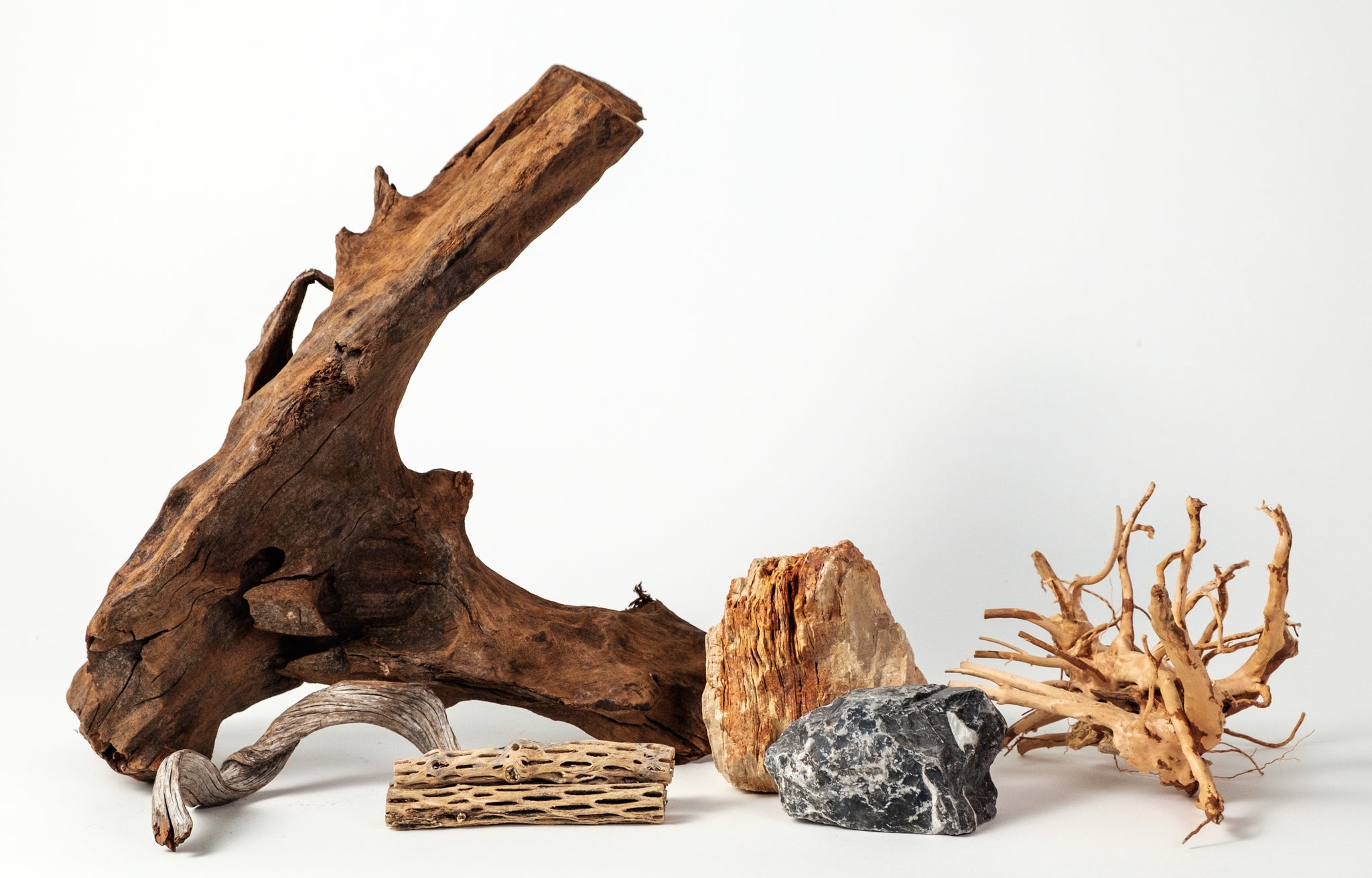
Almost no piece of driftwood or rock is ready to go straight from the bag into your tank. Driftwood floats until it's saturated, leaches tannins that tint the water, and can carry mold or bacteria on its surface; some rocks sold for aquariums will quietly raise your pH and hardness for as long as they're in the tank. None of that means hardscape is risky to use — it means it needs a short prep step first. This guide covers curing driftwood until it sinks and stops bleeding color, telling safe inert rock from reactive stone, and cleaning both before they go anywhere near fish or shrimp.
Why hardscape needs prep before it goes in the tank
Driftwood is, by definition, wood that has already spent time in water or weather, but that doesn't mean it's saturated enough to sink, or clean enough to add to a stocked tank. Dry wood is full of air pockets that make it float — sometimes for weeks — until water fully penetrates the fiber. As it saturates, it also releases tannins, the same compounds that darken tea, which tint aquarium water brown and can nudge pH down slightly. None of that harms fish or shrimp, but an unprepared piece can make a new tank look like weak coffee for longer than most keepers want.
Rock has a different problem. Many attractive, widely sold aquarium rocks — limestone, dolomite, "holey rock," crushed coral, and some marbles — contain calcium carbonate, which slowly dissolves into the water and buffers pH and hardness upward. That's exactly what a hard-water cichlid tank wants and exactly what a soft-water Caridina shrimp tank doesn't. Both driftwood and rock can also carry mold spores, bacteria, or — for anything collected outdoors — pesticide and herbicide residue, which is why a cleaning step matters even for material that looks fine.
Which driftwood is aquarium-safe
Most driftwood sold specifically for aquariums is a safe starting point, but types differ in density, tannin output, and how long they take to sink:
- Malaysian driftwood — dense, dark, sinks readily once saturated; a common, reliable default.
- Mopani wood — very dense, two-toned, tends to leach tannins more heavily and for longer than most other types.
- Manzanita — thin, branching, long-lasting; smaller pieces saturate and sink faster than large driftwood slabs.
- Spider wood — fine, root-like branches (from azalea/rhododendron root systems sold for aquarium use); visually striking, usually sinks fairly quickly.
- Cholla wood — porous cactus skeleton, not true driftwood; it's meant to slowly break down and is popular for shrimp and fry to graze on, not a permanent hardscape piece.
Avoid resinous softwoods (pine, cedar, fir), anything from grapevine, walnut, yew, lilac, horse chestnut, or rhododendron/azalea branches above the root system, and any wood that's been painted, stained, pressure-treated, or collected from a sprayed lawn, roadside, or farm edge. If you can't confidently identify a piece you found outdoors, treat that uncertainty as a reason to skip it rather than a detail to work around.
How to cure driftwood: soak until it sinks
Curing is the process of saturating wood fully (so it sinks on its own) and leaching out the heaviest tannins before it goes in a display tank:
- Scrub the surface under running water to remove loose bark, dirt, and debris — no soap or detergent.
- Submerge it fully in a bucket or tub of plain dechlorinated water, weighing it down if it floats (a clean rock or suction-cup-and-fishing-line rig both work).
- Change the water every 1-3 days as it darkens with tannins, especially in the first week.
- Keep going until the piece sinks unassisted and the water stays only lightly tinted between changes rather than turning dark within a day.
- Do a final rinse before placing it in the display tank.
Expect roughly 3-7 days for smaller, less dense pieces like manzanita or spider wood, and one to three weeks for larger Malaysian driftwood or mopani — size and density matter more than wood type alone. Even fully cured wood keeps leaching a little tannin indefinitely, just at a much slower, cosmetic rate; running activated carbon in your filter for the first few weeks after adding it will keep water clearer if you don't want the tinted look.
Should you boil driftwood first?
Boiling sterilizes the surface, waterlogs the wood faster, and can soften some tannin release — but it's a head start, not a substitute for the soak above. A small-to-medium piece that fits in a large pot can be boiled for an hour or so per side, then moved into the same soak-and-swap routine until it sinks and runs mostly clear. For anything too large to boil evenly, skip it: uneven heating on an oversized piece risks cracking or warping it, and a longer plain soak gets you to the same result without that risk. Either way, boiling alone — without the follow-up soak — does not finish curing the wood.
Some guides recommend an aquarium-salt (not table salt) soak in a separate bucket, outside the display tank, to help sterilize wood and nudge it toward sinking faster. That salt water never touches your tank — rinse the wood thoroughly and finish curing it in plain dechlorinated water before it goes anywhere near fish or shrimp.
Which rocks are safe for a freshwater tank
Inert rock — stone that doesn't dissolve or react with water chemistry — is the safe default for a community or planted tank where you want stable, predictable parameters:
| Rock type | Affects water chemistry? | Typical use |
|---|---|---|
| Quartz, slate, lava rock, most river stone | No (inert) | General hardscape, any tank |
| Dragon stone / Ohko (true, non-reactive variety) | Usually no | Aquascaping, popular for iwagumi-style layouts |
| Seiryu stone | Slightly — mild hardness increase | Aquascaping; fine for most community tanks, less ideal for very soft-water species |
| Limestone, dolomite, "holey rock," crushed coral, most marble | Yes — raises pH, GH & KH over time | Hard-water or African cichlid tanks only, not soft-water shrimp or blackwater setups |
If you're building a tank around soft-water species — Caridina shrimp, many South American fish — a reactive rock can undo the exact water chemistry you're trying to hold steady, even if it looks identical to an inert piece on the shelf.
The vinegar test: checking if a rock is reactive
You don't need a lab to screen a rock before it goes in the tank. Put a few drops of plain white vinegar directly on a clean, dry section of the rock's surface and watch closely:
- Fizzing or visible bubbles mean the rock contains calcium carbonate and will buffer pH and hardness upward over time — treat it as reactive.
- No visible reaction is a good sign, though it isn't a complete guarantee on a rock with mixed mineral content or an unfamiliar origin.
Test a few different spots on an irregular rock, since mineral content isn't always even across one piece. When in doubt, especially for a shrimp or soft-water tank, treat an untested rock the same way you'd treat an unidentified driftwood species — leave it out rather than risk it.
Cleaning and decontaminating rock
Even inert rock sold for aquarium use typically needs a cleaning pass before it goes in:
- Scrub off dirt and loose debris under running water — a stiff brush works for most textures.
- Boil for 15-20 minutes if the rock is small enough to submerge fully in a pot; this kills off surface bacteria, parasites, or mold without needing any chemical cleaner.
- For rock too large to boil, a thorough scrub and rinse is the practical alternative — just give it extra time and attention on crevices and porous surfaces.
- Never use soap or household cleaner, which can leave a residue that's difficult to fully rinse out and is toxic to fish and shrimp at far lower concentrations than you'd expect.
Securing hardscape so it doesn't shift or float
A piece that isn't fully cured can still try to float weeks after you've placed it, and a tall or top-heavy rock stack can topple and crack the glass or crush livestock. A few practical safeguards: weigh down any driftwood that still wants to float with a cured rock or an aquarium-safe weight until it's fully saturated; stack rock with the widest, flattest pieces at the base; and for anything tall relative to the tank's footprint, consider aquarium-safe epoxy or putty at the contact points, placed before substrate goes in rather than after. See our first planted tank guide for how hardscape placement fits into the rest of a build, and our cycling guide for why it's worth finishing hardscape prep before you start the nitrogen cycle, not during it.
How long does driftwood take to cure before it's safe to add to a tank?
Small, dense pieces like manzanita or spider wood can sink and stop leaching heavily within a few days to a week. Larger, less dense pieces like Malaysian driftwood or mopani often take one to three weeks of continuous soaking, with regular water swaps, before they sink on their own and tannin color drops off sharply.
Why does new driftwood turn the water brown, and is it dangerous?
The tea-brown tint is tannins, naturally occurring compounds leaching out of the wood. They're not toxic to fish or shrimp and many keepers like the look, but they do soften water slightly and can lower pH a little over time. If you want clear water, keep soaking and swapping water until the tint fades, or run activated carbon once the wood is in the tank.
Do I need to boil driftwood, or is soaking enough?
Boiling sterilizes the surface and speeds up water absorption, but it doesn't finish the curing process on its own — soaking afterward is still needed until the piece sinks and stops leaching heavily. For large pieces that won't fit in a pot, skip boiling; the cracking and warping risk from uneven heating usually isn't worth it, and a longer soak gets you to the same result.
How do I know if a rock will raise my aquarium's pH or hardness?
Put a few drops of white vinegar on the rock's surface. Fizzing or bubbling means it contains calcium carbonate (as limestone, dolomite, holey rock, and crushed coral do) and will buffer pH and hardness upward over time. No reaction is a good sign, though it's not a complete guarantee on mixed or unknown stone.
Can I use wood or rocks I collected outside instead of buying aquarium-specific pieces?
You can, with real caveats: identify the wood species first (avoid resinous softwoods like pine or cedar, and any treated or painted lumber), and skip anything collected near treated lawns, roadsides, or farmland where pesticide or herbicide residue is a realistic risk. Boil or cure it at least as thoroughly as a store-bought piece before it goes anywhere near a tank.
Will curing driftwood in salt water make it unsafe for a freshwater tank?
Some guides recommend a saltwater or aquarium-salt soak outside the tank to help sterilize wood and speed curing — that's a separate container, not your display tank, and the wood gets rinsed and then soaked in plain dechlorinated fresh water afterward. If you're not comfortable with that extra step, a plain dechlorinated-water soak with regular water changes works fine too, just somewhat slower.