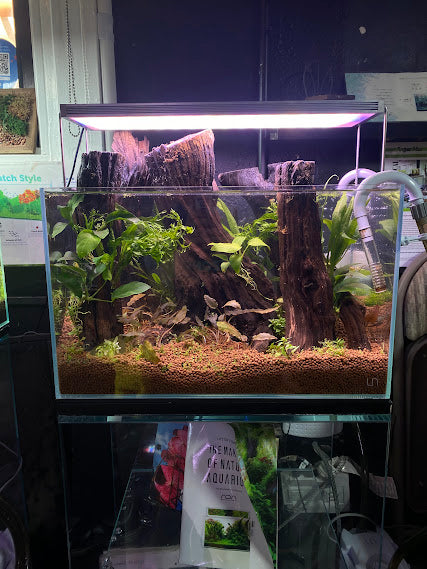
Of all the equipment in a new tank, the heater is the piece most often bought by whatever number is printed on the box rather than one actually matched to the tank, the room, and a real safety plan. Undersized, it runs constantly and still can't hold temperature through a cold night. Oversized with no backup, a stuck-on failure can cook a tank before anyone notices. This guide covers sizing it correctly, where to put it, and the handful of safety habits that turn a heater failure from a disaster into a non-event. If you haven't set up a tank yet, our equipment guide covers the full starter list; if you're deciding whether goldfish and heated tropical fish can share one setup, our goldfish vs. tropical fish guide covers why they can't.
Does your tank even need one?
True coldwater fish — goldfish above all — do best at a stable 65-75°F and often get by without a heater at all in a climate-controlled home, as covered in our goldfish vs. tropical fish guide. Nearly everything else sold as a freshwater community fish — tetras, livebearers, gouramis, corydoras, most cichlids — needs a stable 75-82°F year-round, and ambient room temperature rarely holds that line overnight or through a cold front, even in a warm house. Unless you're specifically keeping coldwater species, plan on a heater — see our beginner freshwater fish picks for which popular starter species actually need one.
Sizing: how many watts
The long-standing rule of thumb is roughly 5 watts per gallon on smaller tanks, assuming a typical indoor room and a lid that limits evaporative cooling, tapering down to around 3.5 watts per gallon as tanks get larger and their volume-to-surface-area ratio improves (Fish Laboratory, Aquarium Heater Guide). If you're not sure which row below matches the tank you have, our standard aquarium sizes chart lists real gallon counts by dimensions, since a "20 gallon" long and a "20 gallon" high don't hold the same water or need the same wattage:
| Tank size | Typical heater wattage |
|---|---|
| 5-10 gallons | 50W |
| 15-20 gallons | 100W |
| 25-40 gallons | 150W |
| 50-60 gallons | 200W |
| 75-100 gallons | 250-300W, often split across two heaters |
For a more precise figure than a flat per-gallon rule, Aquarium Co-Op's baseline is 5 watts per gallon for a 10°F rise above room temperature under a lid (Aquarium Co-Op, How to Choose the Right Aquarium Heater), which scales to other temperature gaps with the formula (target temp − room temp) × gallons ÷ 2 (Fish Laboratory) — a 50-gallon tank held at 78°F in a 70°F room works out to (78−70) × 50 ÷ 2 = 200 watts. The two methods won't always land on exactly the same number; when they disagree, round up to the next available wattage rather than down. An undersized heater doesn't just heat slowly — it runs at full output nonstop and still may never reach its set point on a cold night, which also shortens its working life.
A cooler room, a basement or garage installation, an open-top tank with no lid, or other equipment adding unwanted heat loss (or, for a canister filter's motor, a small amount of unwanted heat gain) all shift the real number — treat every chart here as a starting point to size from, not a guarantee.
One big heater, or two smaller ones?
Once a tank needs roughly 200 watts or more — generally the 75-100 gallon range and up — splitting that wattage across two smaller heaters in different spots is the safer setup: a 200-watt total becomes two 100-watt units rather than one 200-watt unit (Aquarium Co-Op). The redundancy cuts both ways. If one heater fails off, the other keeps most of the tank from going cold while you notice and replace it. If one fails stuck-on, the tank's total volume and the second heater's comparatively modest output put a real ceiling on how hot the water can climb before you catch it — something a single oversized heater can't offer.
Heater types
| Type | How it works | Best for |
|---|---|---|
| Submersible | Fully underwater, usually glass or glass-free with a suction-cup mount; the most common type | Nearly any tank; flexible placement, including horizontal |
| Immersible (hang-on) | Hangs from the rim with only part of the unit underwater; can't be fully submerged | Older or budget setups; less flexible placement, increasingly uncommon |
| Substrate / pad | A low-wattage pad or cable installed under the substrate, often at a fixed, non-adjustable temperature | Nano and betta tanks where a full-size heater is impractical |
| In-line (external) | Plumbed into filter or pump tubing outside the tank; heats water as it's pushed through | Larger or planted tanks where an in-tank unit would be visible or in the way |
Submersible heaters cover the overwhelming majority of freshwater setups and are what the sizing numbers above assume (Fish Laboratory).
Placement: where it actually works
- Near water movement — close to a filter's intake or outflow, so heated water actually circulates past the tank instead of pooling around the heater's own sensor, which can make the thermostat cut off before the rest of the tank has warmed (Fish Laboratory).
- Horizontal, near the bottom, in taller tanks — warm water rises on its own, so a horizontally-mounted heater low in the tank distributes heat more evenly than one left near the surface, where the bottom stays noticeably cooler (Fish Laboratory).
- A small gap from the substrate — don't bury or rest the heater directly against the gravel or sand layer.
- Spread apart on multi-heater tanks — place each unit in a different area rather than side by side, so one failing doesn't leave the other working in the same cold or hot spot it was already compensating for.
Safety habits that matter most
The heater is the one piece of aquarium equipment most capable of doing real harm if it fails quietly. None of the habits below are difficult — they're just easy to skip until the one time it matters.
- Protect the circuit with a GFCI outlet. A ground fault circuit interrupter cuts power the instant current starts taking an unintended path — through water and potentially a person — rather than waiting for a standard breaker to trip on overcurrent, which a small ground fault may never cause by itself; GFCI protection on every aquarium-connected circuit is a widely recommended baseline, not an optional upgrade (Reef Builders, What You Need to Know About Aquariums and Electrical Safety).
- Use a drip loop. Route each cord so it dips below the outlet before running up to it, so any water that travels down the cord drips onto the floor instead of into the socket (Reef Builders).
- Verify the dial with a separate thermometer. Heater thermostats can drift off their set point over months of use even when the unit looks and feels completely normal, which is also flagged in our equipment guide — checking the two against each other is worth adding to the recurring checks in our maintenance schedule guide.
- Never unplug and immediately pull a hot heater into cool air or rinse it under cold water — the sudden temperature swing on the glass can crack it. Unplug it, give it several minutes to cool with the water still around it, then remove it.
- If a heater is visibly stuck on (temperature climbing and not stopping), unplug it immediately, then bring the tank down gradually with partial water changes of cooler dechlorinated water and extra surface agitation — not an ice bath or a sudden full change, which risks shocking fish that are already heat-stressed.
Common heater mistakes
- Buying by the number on the box instead of matching wattage to actual gallons, room temperature, and whether the tank is covered.
- One oversized heater with no backup on a large tank, instead of splitting the load across two units once a tank calls for roughly 200 watts or more.
- Placing the heater in a dead zone away from any filter flow, so its own sensor reads warmer than the rest of the tank actually is.
- Trusting the thermostat dial alone, with no independent thermometer to catch drift before it becomes a problem.
- No GFCI protection on the outlet or circuit powering tank equipment.
Does every freshwater tank need a heater?
No. True coldwater fish like goldfish do best at a stable 65-75°F and are usually fine without one in a climate-controlled home. Almost every tropical community fish needs a stable 75-82°F year-round, which ambient room temperature alone rarely holds overnight or through a cold spell — see our goldfish vs. tropical fish guide for why the two ranges don't overlap enough to share one tank and one heater setting.
What wattage heater do I need for my tank size?
Roughly 5 watts per gallon for tanks under about 40 gallons, tapering to about 3.5 watts per gallon on larger tanks, assuming a typical room and a lid that limits evaporative cooling. A cold room, an uncovered tank, or a bigger desired temperature rise all push that number up — round up to the next available wattage rather than down, since an undersized heater just runs at 100% duty cycle without ever reaching the set point.
Should I use one big heater or two smaller ones?
On tanks roughly 75-100 gallons and up, splitting the needed wattage across two smaller heaters in different spots is the safer choice. If one fails off, the other still slows the drop; if one fails on (stuck heating), it can only push the water partway toward dangerous before the tank's total volume and the second heater's cooler output limit the damage — a single oversized heater has no such backup.
Where should a heater go in the tank?
Somewhere with steady water movement, ideally near a filter's intake or outflow, so heated water actually circulates instead of pooling around the heater's own sensor. In taller tanks, position a submersible heater horizontally near the bottom (warm water rises on its own) with a small gap from the substrate, rather than near the surface where the bottom stays cooler.
Do I need a GFCI outlet for my aquarium?
It's a widely recommended safety step for any circuit powering aquarium equipment, heaters included. A ground fault circuit interrupter cuts power the moment current starts taking an unintended path — through water and into a person, for example — rather than waiting for a breaker to trip on overcurrent, which a small ground fault may never cause on its own.
How do I know if my heater has failed?
Compare its dial setting against a separate, independent thermometer regularly — thermostats drift off their set point over months of use even when the heater looks and feels fine. A reading that's climbing steadily and won't stop means a stuck-on heater: unplug it immediately, then cool the tank gradually with partial water changes and extra surface agitation rather than anything sudden, which can shock already-stressed fish.