Search "easy freshwater fish" and you'll get roughly the same list everywhere: guppies, common plecos, tiger barbs, a betta, sometimes a goldfish that shouldn't be in a tropical tank at all. Some of those are genuinely fine choices. Several are popular mostly because they're cheap and sell fast, not because they hold up well in a new 20-gallon tank with an owner who's still learning to read a test kit. "Beginner-appropriate" and "commonly sold to beginners" are different categories, and mixing them up is a big part of why first tanks go sideways. This guide keeps them separate, with real adult sizes and group minimums instead of numbers that get copy-pasted from one care sheet to the next.
What Actually Makes a Fish Beginner-Appropriate
Five things, roughly in order of how often they get skipped:
- Tolerance for water-quality swings. Every new tank goes through weeks of fluctuating ammonia and nitrite before the bacterial colony that processes fish waste catches up — see our cycling guide for the actual timeline. A fish that can shrug off a brief ammonia bump is a fundamentally different proposition from one that needs pristine, stable water from day one.
- Peaceful temperament. Not just "won't kill anything," but won't chronically stress or nip at slower, longer-finned tankmates — which, as covered below, disqualifies a few fish that get marketed as easy anyway.
- A realistic adult size for a starter tank. The fish you buy at 1.5 inches in a store tank is not the fish you'll have in a year. Several commonly sold "beginner" fish grow well past what a 20- or 40-gallon tank can support.
- An easy diet. Takes flake or pellet food readily, doesn't require live or frozen food to survive.
- Wide availability and disease resistance when properly sourced. Widely bred, farm-raised fish tend to arrive hardier and better acclimated than wild-caught specialty species — but only if the store you buy from quarantines new stock rather than shelving it straight off the truck.
A fish that only satisfies "cheap and tolerates neglect" isn't the same as a fish suited to a beginner's tank. Keep that distinction in mind through the rest of this guide — it's the whole point of it.
Popular Picks That Aren't Actually Great Beginner Choices
The "Common" Pleco
Sold small, cheap, and marketed as an algae-eating cleanup crew, the common pleco (usually Hypostomus plecostomus or a similar Pterygoplichthys species) is one of the most mis-sold fish in the hobby. Adults reach 15 to 24 inches and need a minimum 100-gallon tank, per AquAnswers' size comparison across pleco species. The 3-inch juvenile in a store tank gives almost no visual warning of where it's headed. If you want a pleco-shaped algae eater that actually fits a 30-gallon starter tank, the bristlenose pleco (Ancistrus sp.) tops out around 3 to 6 inches and is the one worth buying instead — see the bottom-dweller section below.
Tiger Barbs
Tiger barbs are hardy, colorful, and genuinely easy to keep alive — the problem is temperament, not survivability. Kept in groups smaller than about eight, they redirect the hierarchy-establishing behavior meant for their own species onto tankmates, nipping at anything with flowing fins or slow movement, according to AquariumStocking's care and aggression notes. A beginner who buys the typical "starter" group of three or four tiger barbs is buying a fin-nipping problem, not an easy community fish. In a proper group of 8-10+, they settle down considerably; most beginner tanks aren't stocked with that many barbs. (Other fish marketed as easy tetras, serpae tetra among them, have a similar reputation for nipping when kept too few — worth checking before you buy, not after.)
Betta as a "Community Starter Fish"
Bettas aren't a bad beginner fish on their own — a lone betta in a properly cycled 5-gallon-plus tank is genuinely low-maintenance. The trouble is how they're marketed: as a drop-in addition to whatever community tank you're already planning. Individual betta temperament varies enormously, and several of the most commonly suggested betta tankmates are actually poor matches — goldfish need cooler water than a betta can tolerate long-term (see our goldfish vs. tropical fish guide for why that pairing never works), and fin-nippers or similarly-shaped fish like angelfish provoke exactly the aggression a betta is known for, per AquariumStoreDepot's betta tankmate breakdown. If you want a betta in a community setup, plan for a backup tank in case that particular fish doesn't tolerate company — and don't assume any betta will work with any of the fish below just because another betta did. See our full betta care guide for tank size, heating, and the fin problems that water quality actually causes.
None of this means "avoid these fish forever." It means don't buy them as your first fish on the strength of a pet-store endcap. A bristlenose pleco, a properly-sized barb school, or a solo betta in the right tank can all be excellent choices once you know what you're taking on.
Schooling Fish Worth Building Around
Schooling fish are usually the right foundation for a first community tank — they're active, visible, and (done right) low-conflict. The catch is that "schooling" numbers on old care sheets tend to undersell what these fish actually need to feel secure.
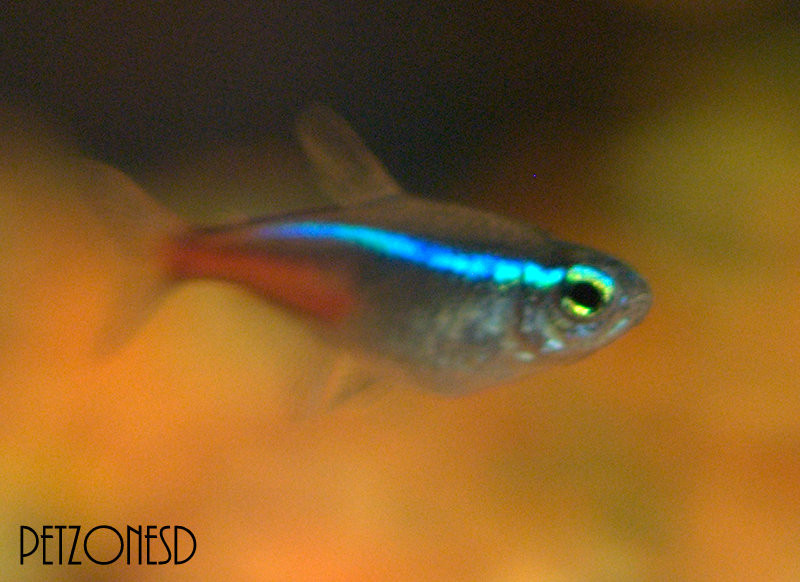
Neon Tetra
Adults run about 1.5 inches in the commercially bred stock most stores sell. AquariumSource's care guide lists 6 as an acceptable minimum but recommends 10 or more for natural schooling behavior, in a tank of at least 20 gallons. Water in the 70-81°F range, slightly acidic (pH under 7) is ideal, though neons tolerate moderate hardness better than their look-alike cousin, the cardinal tetra (see below). One caveat: neons are sensitive to the ammonia and nitrite swings of a newly cycled tank, so they do better added a few weeks into stocking than as the very first fish — see the stocking-order section below.
Harlequin Rasbora
A slightly larger, arguably hardier alternative to tetras: adults reach 1.75-2 inches, and Fishkeeping World's species profile recommends schools of 8-10 or more in a tank of at least 20 gallons (10 gallons is workable for a smaller group, but tight). They tolerate a wider pH range than neons — roughly 6.0 to 7.8 — which makes them a bit more forgiving of average tap water.
Worth flagging: the visually similar cardinal tetra is often shelved right next to neon tetras and looks like a straight upgrade, but it needs soft, acidic water (pH below 6.2, hardness under 4 dGH) to thrive long-term, per AquariumStoreDepot's cardinal-vs-neon comparison. Treat it as a fish to add later, once you're managing water chemistry deliberately, not a beginner's first choice.
A Peaceful Centerpiece
Honey Gourami
A genuinely underrated centerpiece fish for small community tanks. Adults stay around 2 inches, and Aquarium Co-op's care guide describes them as peaceful community fish that get along with tankmates of similar size, comfortable in a 10-gallon alone or 20 gallons for a small group. Like bettas, they have a labyrinth organ that lets them gulp air at the surface, which makes them more tolerant of the oxygen and water-quality fluctuations common in a beginner's tank. Water parameters are forgiving — pH 6.0-8.0, temperature 74-82°F.
Platies, If You Want Livebearers Instead
Platies aren't a schooling fish, but they're about as low-maintenance as freshwater fish get, and their constant, unhurried activity gives a tank a centerpiece-adjacent feel without a true centerpiece fish. Females reach about 2.5 inches, males closer to 1.5, and Fishlore's platy care sheet recommends one male per two females to keep males from harassing a single female. Water parameters are wide — pH 7-8, temperature 65-77°F, meaning platies tolerate cooler, harder water than most of the fish on this list. One thing to plan for: platies breed readily, and without any intervention a tank will slowly fill with fry. Keeping a single-sex group sidesteps that if you don't want to deal with it.
Bottom of the Tank
Corydoras Catfish
The default recommendation, for good reason. Most corydoras species run 2 to 3 inches as adults, and both Aquarium Co-op and Fishlore's corydoras profile recommend groups of six or more of a single species — corys are genuinely social and noticeably more active and confident in a proper group than a pair or trio. A 20-gallon tank comfortably fits a group of the standard-sized species; smaller pygmy corydoras can work in a 10- to 15-gallon. Water parameters are wide (pH 6.5-7.8, temperature 72-82°F depending on species), and they're not fussy eaters — sinking pellets or wafers plus whatever makes it past the fish above them. One care note that matters for their comfort, not just their looks: use sand or smooth, rounded gravel, since corys root through substrate with sensitive barbels that coarse gravel can damage.
Kuhli Loach, With a Caveat
Kuhli loaches are a fun, genuinely peaceful bottom dweller, but they're a step up from corydoras in what they demand from the group size. Adults reach 3 to 4 inches, and per AquariumStoreDepot's kuhli loach guide, a group needs to be at least eight to bring the fish out of hiding during the day — smaller groups will spend most of their time buried in substrate or wedged behind decor, which defeats the point of keeping them. That means a bigger commitment than a starter 20-gallon tank usually allows (30 gallons is a more realistic minimum for a proper group), plus a preference for soft, slightly acidic water (pH 5.5-6.5) and fine sand they can burrow into without injury. Worth adding once you've got a tank running well, not as your very first bottom-dweller purchase.
| Fish | Adult size | Group / minimum | Tank size | Temp / pH |
|---|---|---|---|---|
| Neon tetra | ~1.5 in | 6 min, 10+ ideal | 20 gal | 70-81°F / below 7.0 |
| Harlequin rasbora | 1.75-2 in | 8-10+ | 20 gal | 72-81°F / 6.0-7.8 |
| Honey gourami | ~2 in | solo or small group | 10-20 gal | 74-82°F / 6.0-8.0 |
| Platy | 1.5-2.5 in | 1 male : 2 females | 10 gal+ | 65-77°F / 7.0-8.0 |
| Corydoras | 2-3 in | 6+ | 20 gal | 72-82°F / 6.5-7.8 |
| Bristlenose pleco | 3-6 in | 1 (territorial as adults) | 30 gal | 72-80°F / 6.5-7.5 |
| Kuhli loach | 3-4 in | 8+ | 30 gal | 73-86°F / 5.5-6.5 |
Stocking Order and Acclimation, Briefly
The full explanation of why fish go in gradually — and what's actually happening in the filter while they do — lives in our cycling guide; this is the short version. Don't buy a full stocking list on day one. Add a small group of your hardiest schooling fish first, wait a couple of weeks while checking ammonia and nitrite, then add the next group, working down toward the least tolerant additions last. Bottom dwellers and a centerpiece fish typically go in after the schooling fish are established, not before. When you bring fish home, float the bag to match temperature, then add small amounts of tank water to the bag over 15-20 minutes before netting the fish into the tank — don't pour bag water into the tank itself, since it can carry ammonia or disease from the store's system.
Before you buy anything, it's also worth reading up on which species can actually share a tank long-term — our fish compatibility guide covers the pairings that look fine in a store tank and cause problems six months later, which overlaps with several of the "not great beginner choices" above but goes deeper on stocking a full community rather than picking individual species.
Wherever you buy fish, ask how long they've been quarantined before going on the sales floor. New-arrival stress and disease are two of the biggest predictors of whether a beginner tank stays healthy in its first month, and quarantine practices vary a lot store to store — including ours. See our San Diego aquarium stores guide for what to look for wherever you're shopping.
If you're planting the tank as you go, know that most of the fish above — corydoras and harlequin rasboras especially — do noticeably better in a tank with some cover and a planted substrate than a bare one; see our first planted tank guide if that's part of the plan.
How many fish should I add at once when starting a new tank?
A handful at most, and only after your tank has cycled. Adding a full stocking list on day one overwhelms the beneficial bacteria that haven't built up yet — see our cycling guide for the full timeline.
Do these fish need a heater?
Yes. Every species on this list is tropical and needs a stable 72-82°F, which a home without a dedicated fish room can't hold on ambient temperature alone. Budget for a heater and a separate thermometer, not just the heater's own dial.
Why do some fish marketed as "easy" turn out to be bad choices?
Because "easy" often means "cheap and widely stocked," not "suited to a beginner's tank." A common pleco is genuinely hardy — it's also headed for two feet long. Tiger barbs are genuinely hardy — they're also fin-nippers unless kept in a group most beginners don't buy.
Can a betta live in a community tank?
Sometimes, with the right tankmates and enough space — but individual bettas vary a lot in temperament, and many popular betta-tankmate pairings (fin-nippers, similarly-shaped fish, temperature mismatches) fail. Plan a backup spot for the betta before you buy anything else.
What's the best first fish to add after cycling?
A hardy schooling fish like neon tetras or harlequin rasboras, added a few at a time rather than all at once, so your filter's bacteria can catch up between additions.